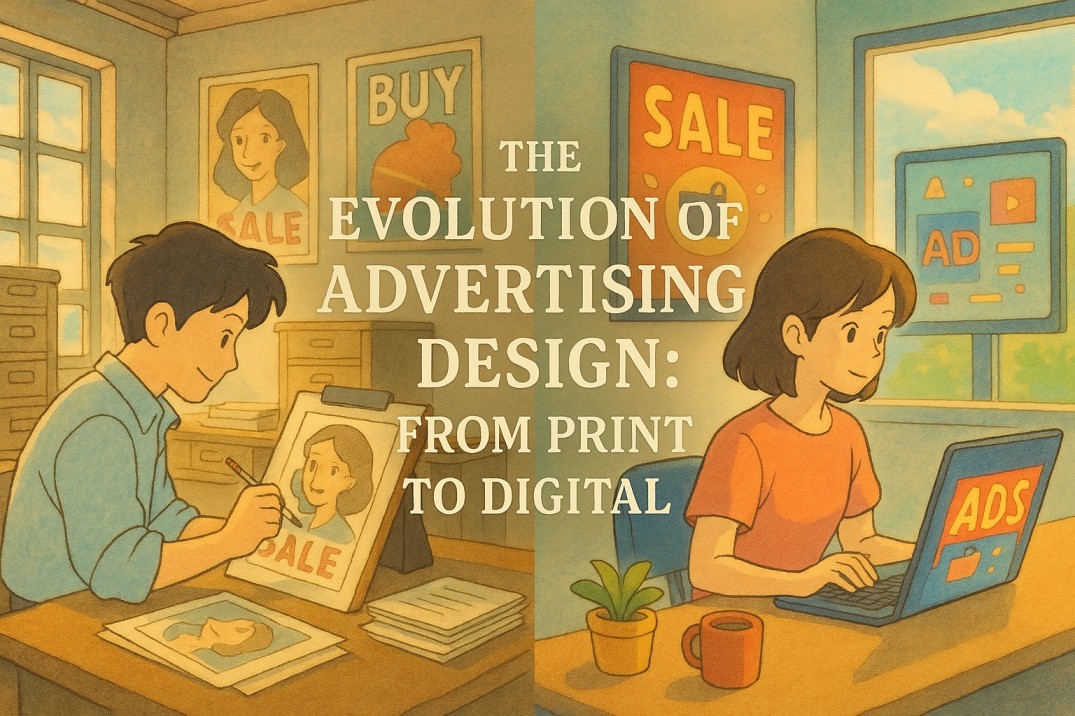
In today’s fast-moving digital world, catching a customer’s attention is more competitive than ever. For instance, with hundreds of ads competing for screen time, businesses rely heavily on the advertising design evolution to make a powerful first impression because design has transformed significantly over time.
Whether it’s a billboard, social media post, or a YouTube pre-roll ad, great advertising design blends creativity, strategy, and psychology to influence buying decisions. Moreover, over time, advertising design has transitioned from traditional print media to immersive digital platforms.
Below, this blog explores that transformation and how advertising has adapted to changing technologies and consumer behaviors.
Traditional Print in the Advertising Design Evolution
Before the internet, advertising design primarily existed in physical formats:
- Newspapers
- Magazines
- Flyers
- Billboards
- Brochures
For example, print ads relied on visual storytelling—with powerful images, bold headlines, and strong copywriting. As a result, designers used typography, color, layout, and illustration to quickly communicate messages. Here are famous campaigns like:
Benefits of print advertising design:
- Tangible and long-lasting
- Effective for local targeting
- High visual impact in public space
Limitations:
- Difficult to measure performance
- Limited reach and engagement
-
Expensive to produce and distribute
Digital Era in the Advertising Design Evolution
With the rise of the internet, the advertising design evolution entered the digital realm. In fact, it brought new formats and platforms that are fast, interactive, and data-driven.
- Social media (Instagram, Facebook, X, LinkedIn)
- Web banners & display ads
- Google Ads (Search & Display)
- YouTube video ads
- Email newsletters and eCommerce promotions
For instance, digital advertising design uses elements like animations, video, interactive graphics, responsive layouts, and clickable buttons to drive engagement. Thus, the focus shifted from one-way communication to two-way interaction, with metrics like likes, shares, comments, and click-through rates becoming essential.
Benefits of digital advertising design:
- Real-time performance tracking
- Budget-friendly and scalable
- Personalized user targeting
- High engagement through interactivity
Limitations:
- Shorter user attention spans
- Ad fatigue due to saturation
-
Requires ongoing updates and optimization
Print vs Digital Advertising Design: Key Differences
While both print and digital design aim to communicate and persuade, they differ in several core ways:
| Aspect | Print Design | Digital Design |
| Medium | Physical (paper, posters) | Screen-based (web, mobile) |
| Interactivity | Static | Interactive |
| Lifespan | Long-term (weeks/months) | Short-term (often seconds) |
| Feedback | Delayed | Instant and measurable |
| Cost | High production cost | Flexible and budget-friendly |
Print and Digital: Better Together in Modern Campaigns
Many brands now blend both strategies to create integrated marketing campaigns, For example:
- Print ads with QR codes leading to digital experiences
- Flyers offering discount codes redeemable online
- Printed catalogs promoted through email and social media
As a result, this hybrid approach allows brands to expand their reach, build and trust while expanding reach and engagement.
Future of Advertising Design Evolution in 2025
The future of advertising design is dynamic, personal, and data-driven. For instance, trends like:
- AR and 3D Design: Immersive ads where users can interact with products virtually (per Creative Bloq).
- AI-Driven Personalization: Real-time ad tailoring based on user data (per Linearity).
- Eco-Conscious Design: Sustainable visuals and energy-efficient formats (per UX Collective).
Therefore, designers will need to stay flexible, creative, and tech-savvy to keep up with the pace of change. However, one thing remains constant: the power of good design to connect, communicate, and convert.
Moreover, for brands aiming to stay ahead in an increasingly competitive landscape, embracing digital advertising design is no longer optional— in fact, it’s essential. Because it allows businesses to reach their audience where they spend most of their time: online. Also, with tools to track performance, optimize in real time, and personalize messaging, digital design provides both flexibility and effectiveness.
At Fuel IT Online, we help your brand to gain the high-impact of digital advertising design—combining creativity with strategy to deliver impactful, data-driven results. So, do contact us!


